

Start with what a product reference actually describes
A solar product data collection review is useful when a company holds information about equipment but cannot tell which parts of that information belong in a present enquiry. A supplier datasheet might describe a model family. An old specification might describe the equipment originally purchased. A digital product record might contain more detailed information about a particular product. None is automatically a statement about the removed items now held in the warehouse. The first decision is therefore modest: what is the source describing, and at what level? Keep the product name, document issuer and version already available in your records. Do not turn an old specification into a present stock count or a promise about how an item will be received.
The European Commission describes a Digital Product Passport as a digital container for product, component and material information, with access organised around different users. That is a useful global information-design comparison: a product reference and the people who can access or explain it are identifiable objects. It is not an Australian solar-panel requirement or a ReSova platform. This article does not say that every photovoltaic module has a passport, that EU provisions apply to an Australian collection enquiry, or that a passport must be created before review.
RMIT’s 1 October 2026 expert comment includes Associate Professor Muhammad Abdulrahman’s call for better lifecycle product transparency. It is an attributed industry discussion, not an announcement of a new Australian passport mandate or a live collection programme. For a warehouse or procurement reader, the practical question is how to use the information already held without giving it more evidentiary weight than it supports. The global request-information article explains the wider enquiry structure. Here, the question is whether a product reference applies to the items and what that reference can actually establish.
Keep model-level information separate from the current items
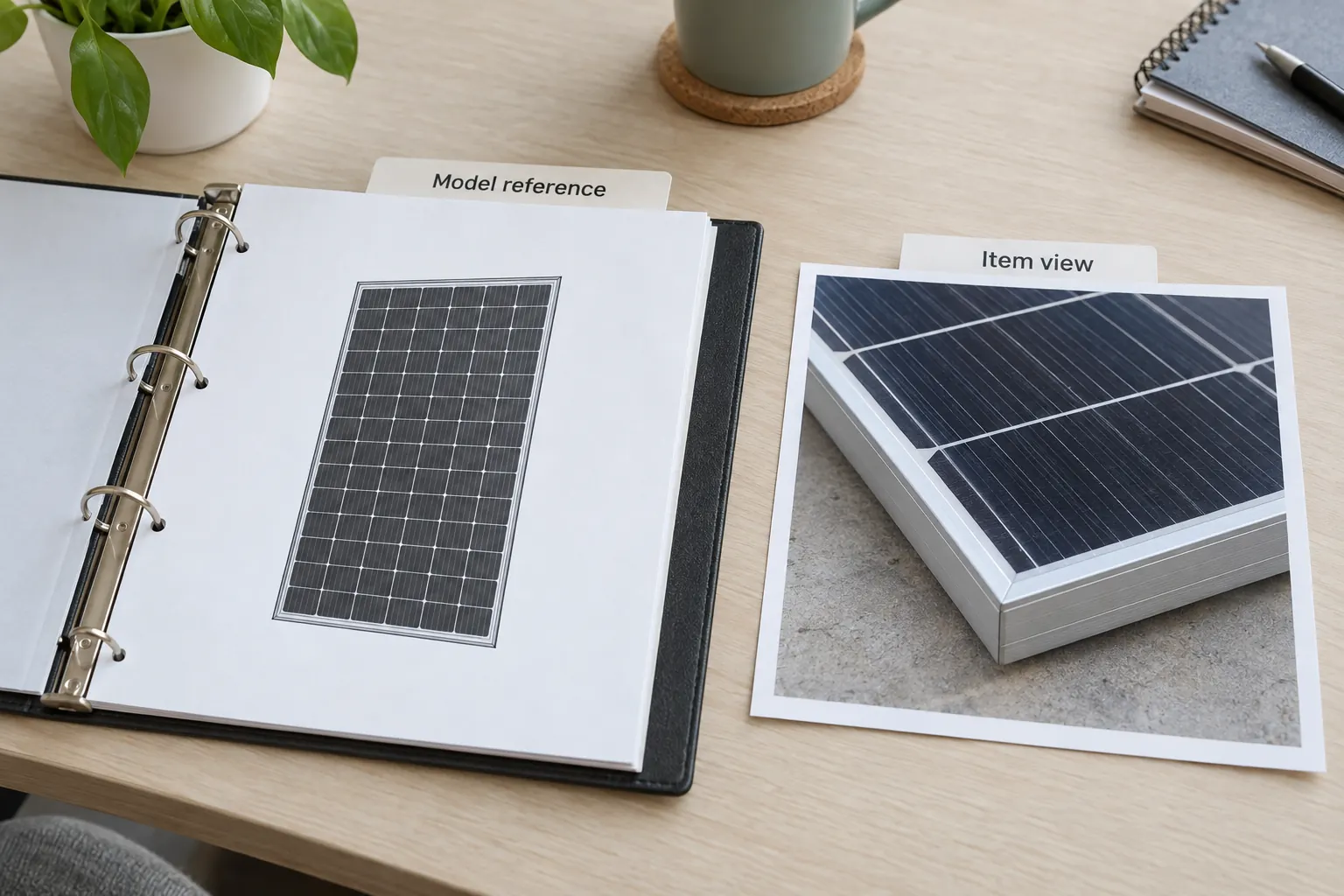
A catalogue image can resemble several versions of a solar panel. A procurement file can also cover equipment that stayed installed, was replaced at another stage or belongs to another property. Even an accurate model name does not identify which current items the document describes. Retain a model-level reference as model-level information unless an existing item reference or responsible fact holder supports a narrower connection. A visible resemblance is not a serial-level match. The mixed-model guide explains how to list panel groups using model details already known.
Check the reference’s stated revision and scope rather than assuming the newest page found online describes an older item. A sheet for another power variant or product revision should not silently replace the reference held in the project file. If two sources disagree, retain the discrepancy and identify who can clarify it. A missing source or unconfirmed relationship remains an information limit. It does not become an invented model, a measured quantity, or an automatic acceptance or rejection rule. There is no instruction here to move, uncover, unpack, open or inspect equipment to obtain missing data.
| Information object | What it can describe when supported | What it cannot establish by itself |
|---|---|---|
| Model datasheet or product record | The source’s declared product identity, revision and stated attributes at model or item level. | Today’s warehouse quantity, removal status, current technical condition or local collection acceptance. |
| Current batch record | The actual equipment and present location reported by the current fact holder, with honest uncertainties. | Manufacturer attributes for unidentified items, electrical testing, reuse suitability or processing results. |
| Separately issued technical report | Only its own stated items, issuer, date, assessment scope and findings. | An assessment of items outside its scope, or a ReSova service or downstream guarantee. |
| Collection handover record | The actual handover details and collected quantity it records. | A statutory certificate, legal compliance determination or proof of every later destination. |
This distinction is particularly important where a company receives equipment from several installer jobs. A product reference may be valid for one source lot while its relationship to another remains unresolved. Keep that limit visible rather than copying a confident description across every lot. For the category quantities and independent readiness of the actual batch, use the mixed-equipment record. A product-information link cannot fill those fields on the team’s behalf.
Keep technical findings and later outcomes with their own evidence
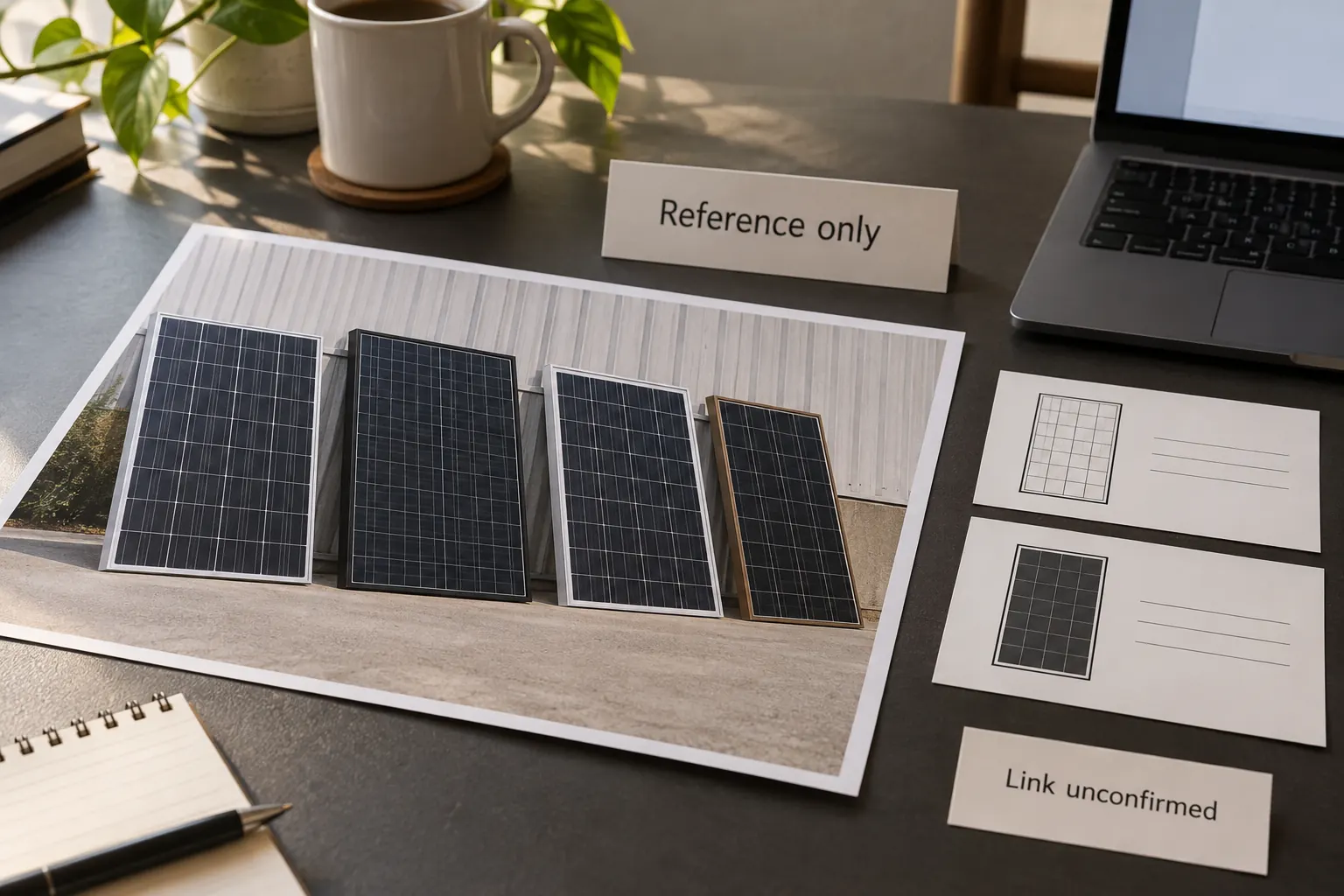
A manufacturer-stated rating is information about a product under the source’s conditions, not a finding about a used item’s performance now. A product record can contain technical information without becoming a technical test of the current batch. The U.S. DOE FEMP lifecycle guide treats refurbishment inspection and testing as a separate subject. That separation is useful for understanding document scope, but the guide’s procedures are not instructions for this enquiry. ReSova does not provide technical testing, and an unresolved performance question is not a request to test equipment merely to complete an administrative note.
If the project already holds a separate contractor report, keep its issuer, date, item references and stated scope intact. Do not widen its findings to other items or paraphrase it into a collection eligibility decision. Likewise, a sustainability statement or product-material declaration is not evidence that these particular panels have been reused or processed. A planned destination is different from a later documented event. Where a project needs another kind of evidence, clarify that need with its responsible party rather than treating a general product reference as a substitute.
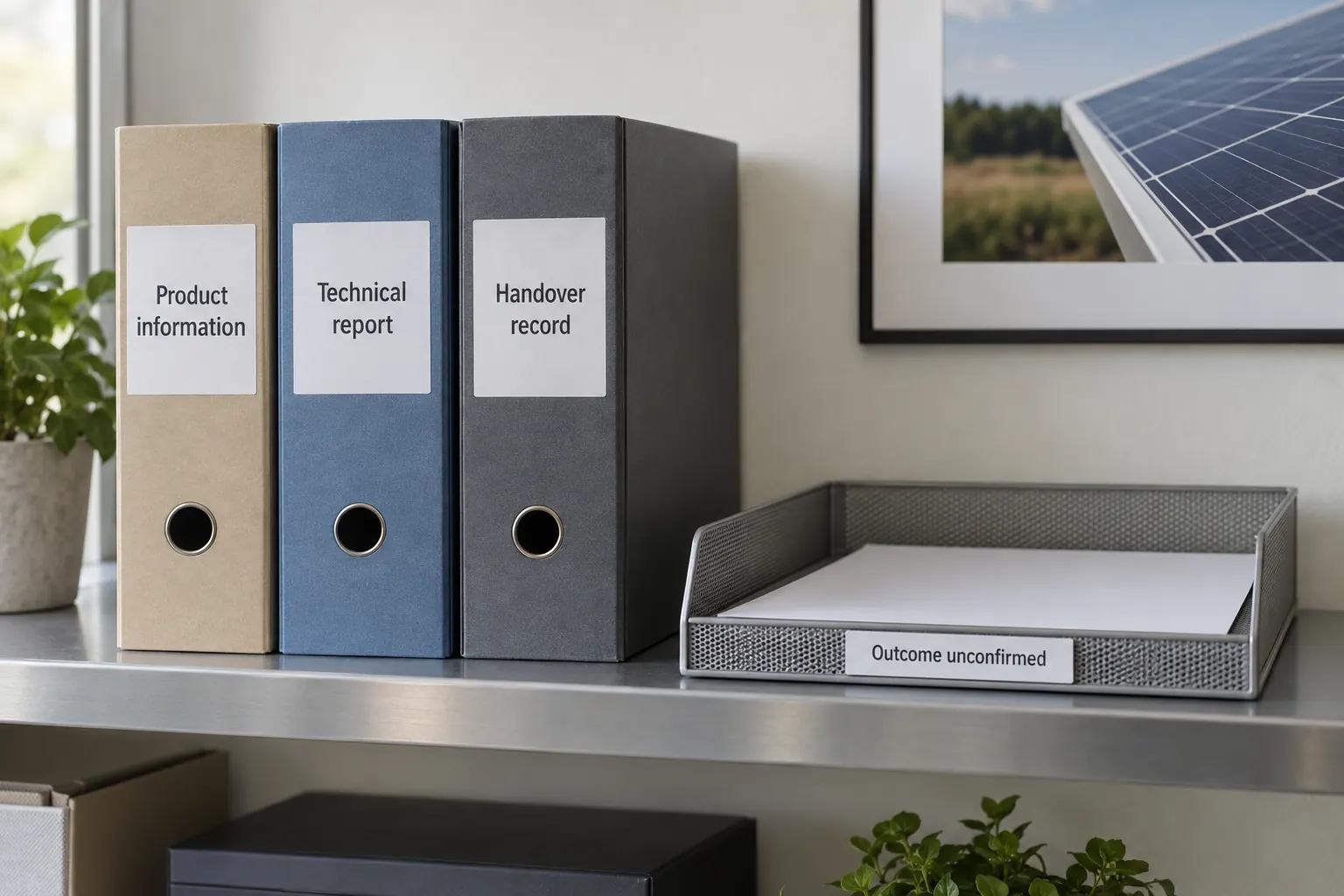
For project-file preparation after pickup, see the collection-records article. Keep each document’s claims within its stated scope even when several records sit in the same project folder. ReSova’s job docket records the handover; it is not a statutory certificate, audit assurance, warranty, electrical test or final-processing proof. A passport link does not turn it into one. This analysis gives no legal interpretation or promise of reuse, recycling, recovery rate, processor or destination.
Carry forward only the facts supported for this enquiry
Consider an illustrative office record, not a ReSova case: the team holds a datasheet titled for Model M and an existing photograph of a removed lot. The current contact can confirm the lot’s ground-level point but cannot confirm which version the sheet describes. A useful note says that the model reference is available and its applicability is unconfirmed. It does not select a model from appearance, import the original purchase quantity, label the items working or infer a recycling pathway. If the responsible person later clarifies the connection, update that reference without changing the limits of what it proves.
An installer can pass on the product references already associated with the removed job and identify uncertainty without performing another inspection. A warehouse coordinator can distinguish source lots and nominate the person who can explain a reference. A procurement team can state which information question it needs answered rather than asking a collection operator to certify a whole lifecycle. A homeowner may simply have an older installer document; there is no need to create a complex product-passport exercise for an ordinary enquiry.
A supported product-reference review flow
- Name the existing sourceKeep its issuer, version and model- or item-level scope. Use information already held; do not create extra handling.
- State the supported connectionIdentify the current equipment the source actually describes, or retain applicability unconfirmed.
- Limit the carried-forward claimKeep product attributes separate from current quantities, visible observations and any separately issued technical findings.
- Preserve unresolved questionsIdentify the responsible fact holder and uncertainty without inventing a match, performance conclusion or downstream result.
- Send the appropriate enquiryProvide the real removed-equipment and handover facts for review; a product reference adds context, not confirmation.
For a local Sydney or selected-NSW request, ReSova assesses equipment appropriately qualified people have already safely removed and made available at ground level. Provide the actual equipment categories and count or uncertainty, broad visible facts, postcode, present handover point, known access facts and authorised contact. Existing product references can add context; their presence does not confirm acceptance, price, vehicle, route, timing or booking. Their absence does not decide those questions either. Use Commercial Services for a mixed, larger, staged, multi-site or otherwise complex enquiry and warehouse collection scope for the current operational context.
Australian Government consumer guidance directs solar-component removal and replacement to licensed electricians. This Article begins after that work. It provides no electrical disconnection, removal, roof-work, site-safety, traffic-management, technical-testing or legal advice. Online time selection remains paused: request review and an availability discussion, not a direct booking. ReSova does not create product passports or guarantee reuse, recycling, recovery rate, processing or a final destination from a product-information record.
Sources and dates checked
- European Commission — Digital Product Passport, checked 12 October 2026: global comparator for product-information containers and distinct user roles. No EU timetable or Australian PV obligation is imported.
- U.S. DOE FEMP — Prepare for the end of a performance period, checked 12 October 2026: global comparator separating inspection/testing and lifecycle decisions; no technical procedure is adopted.
- RMIT — Clean-energy waste expert comment, published 1 October 2026, checked 12 October 2026: attributed product-transparency discussion, not a new mandate or service announcement.
- Australian Government — Replace and recycle your solar system, checked 12 October 2026: professional-removal boundary only.
Key takeaways
- Identify the source's model- or item-level scope before carrying any claim into a current enquiry.
- An available product reference can have an unconfirmed relationship to the actual equipment.
- Product data, current batch facts, technical findings and later handover/outcome evidence are different information objects.
- Use existing references without extra handling, passport creation or an invented eligibility rule.
Frequently asked questions
Must I create a digital product passport before asking ReSova for review?
No. This article does not introduce a product-passport requirement. Describe the current safely removed equipment and handover facts, include product references already available where relevant, and state missing or uncertain information honestly. A request remains subject to assessment.
Does a panel datasheet prove which items are in the current batch?
No. A model-level sheet is not a current inventory or an item-level match. Keep its source and version, identify any supported connection to the actual equipment, and leave that connection unconfirmed where the existing information does not establish it.
Can product information or a handover docket prove reuse or recycling?
Not by itself. Product information, a separately issued technical report, a collection handover record and evidence of a later outcome concern different claims. ReSova's docket is not a statutory certificate, technical test or proof of final processing.
Should equipment be moved or unpacked to complete product references?
No extra handling, opening, dismantling or testing should be undertaken merely for this administrative note. Use existing records and responsible fact holders, retain unknowns, and request clarification without treating a missing reference as an automatic eligibility decision.
Request a Commercial Scope Review
ReSova considers eligible, already removed equipment in Sydney and selected NSW areas after the ground-level handover and site access can be confirmed. It does not decide removal, technical condition or a final downstream outcome.