
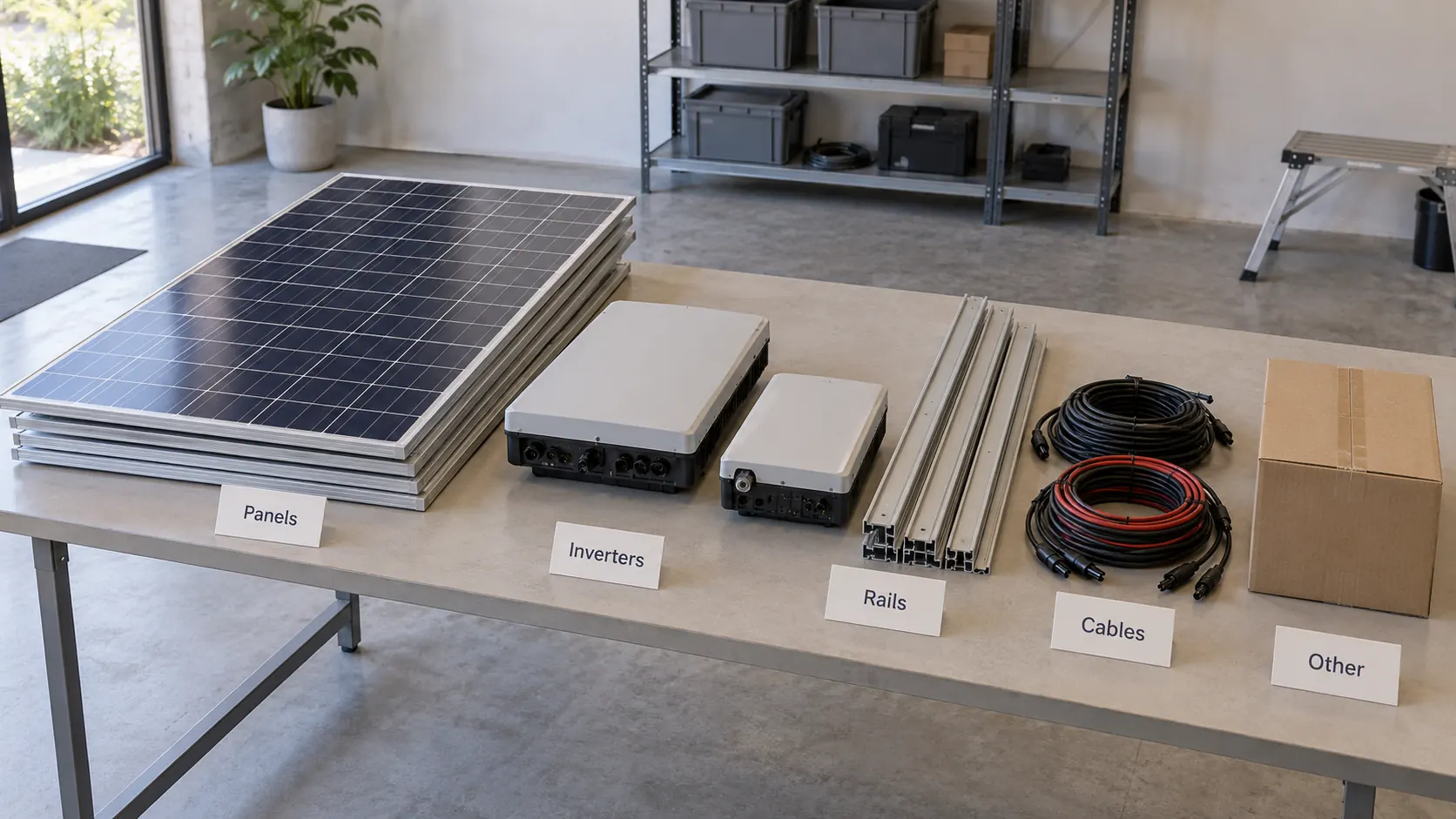
Keep the category and quantity unit together
A mixed solar system equipment record in Sydney needs more than a single total headed ‘old solar system’. Panels, inverters, racking or rails, cables and other disclosed items are different categories. Give each its own line and retain the unit the actual information supports. Twenty-four panels, two inverter units, one existing rail bundle and two cable coils cannot be added into 29 panels or 29 equivalent collection items. That arithmetic would remove the very distinctions a tailored assessment needs.
The equipment-list guide introduces the category overview. This record adds the commercial decision layer: the quantity’s unit, the current readiness of that particular category, its broad visible state and the source confirming the fact. If a bundle count is all the current record supports, keep it as a bundle. Do not infer the number of pieces inside it. If an existing cable record gives coils but not length or weight, keep those latter values unknown. These are descriptions of existing records, not instructions to unbundle, measure, weigh or handle equipment.
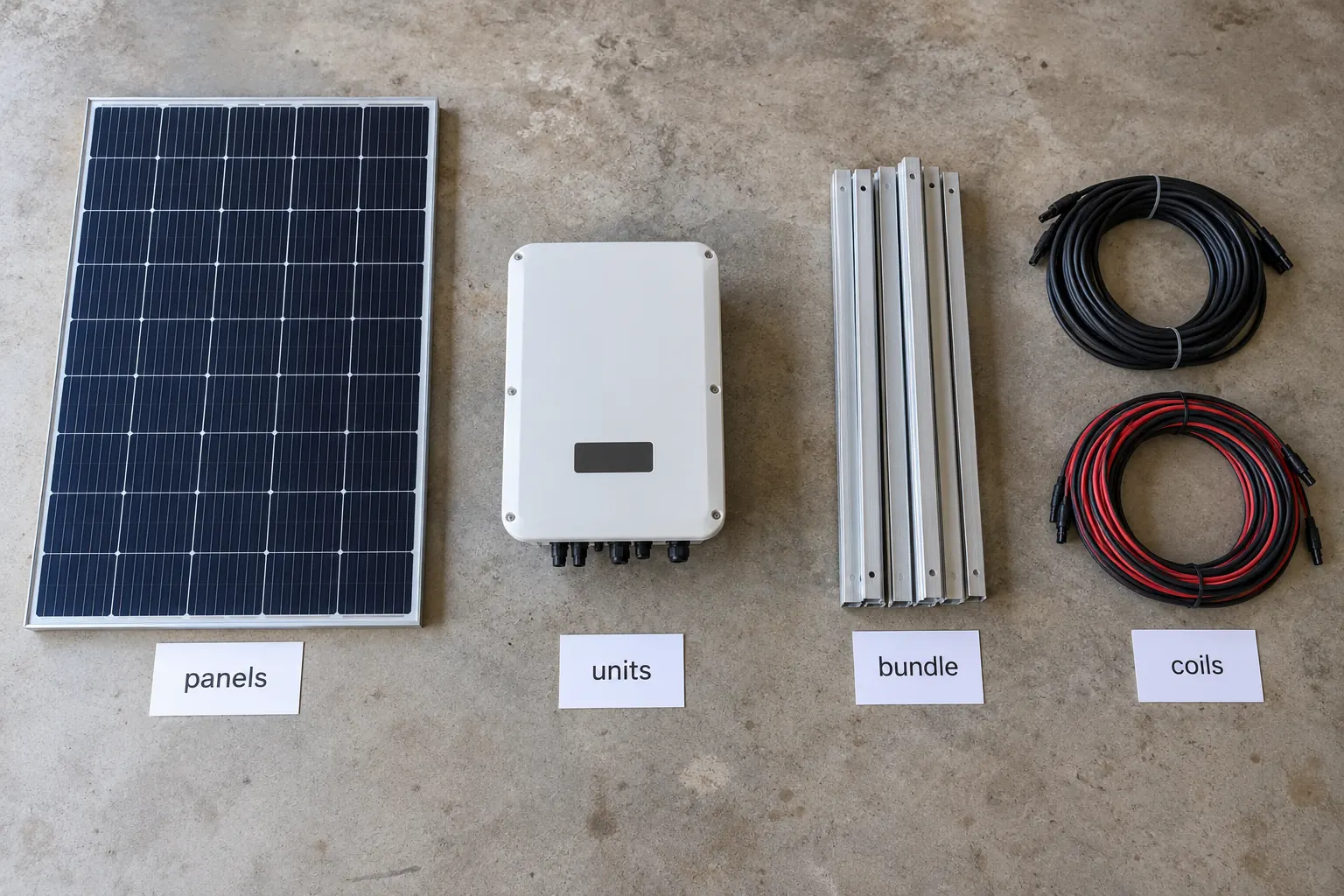
The U.S. EPA’s current information distinguishes solar panels from related equipment such as inverters and racking. The DOE FEMP guide likewise treats the PV array and balance-of-system components separately. Those are useful global information-structure comparisons, not rules deciding what ReSova accepts. Our local record must describe the actual already safely removed equipment at the named ground-level point, and each disclosed category remains subject to review.
Record current readiness independently for every category
A panel row can be current while an inverter row is still a future project task. A warehouse can also hold rails from an older job alongside equipment belonging to this request. For each category, ask the administrative question: does the responsible fact holder confirm that these exact items have already been safely removed and are currently available at this ground-level handover point? A shared project name, an old asset entry or a photograph of nearby equipment does not answer that question for every row.
Keep installed or connected equipment and later-stage material outside the current ready quantities. Retain it separately as project context if the team needs it, without describing it as equipment ReSova will disconnect or remove. The replacement ready-batch brief owns the wider phase/forecast distinction. The company asset-register guide explains historical records. Here, apply that boundary separately to each equipment category, including categories with unknown counts or unidentified contents.
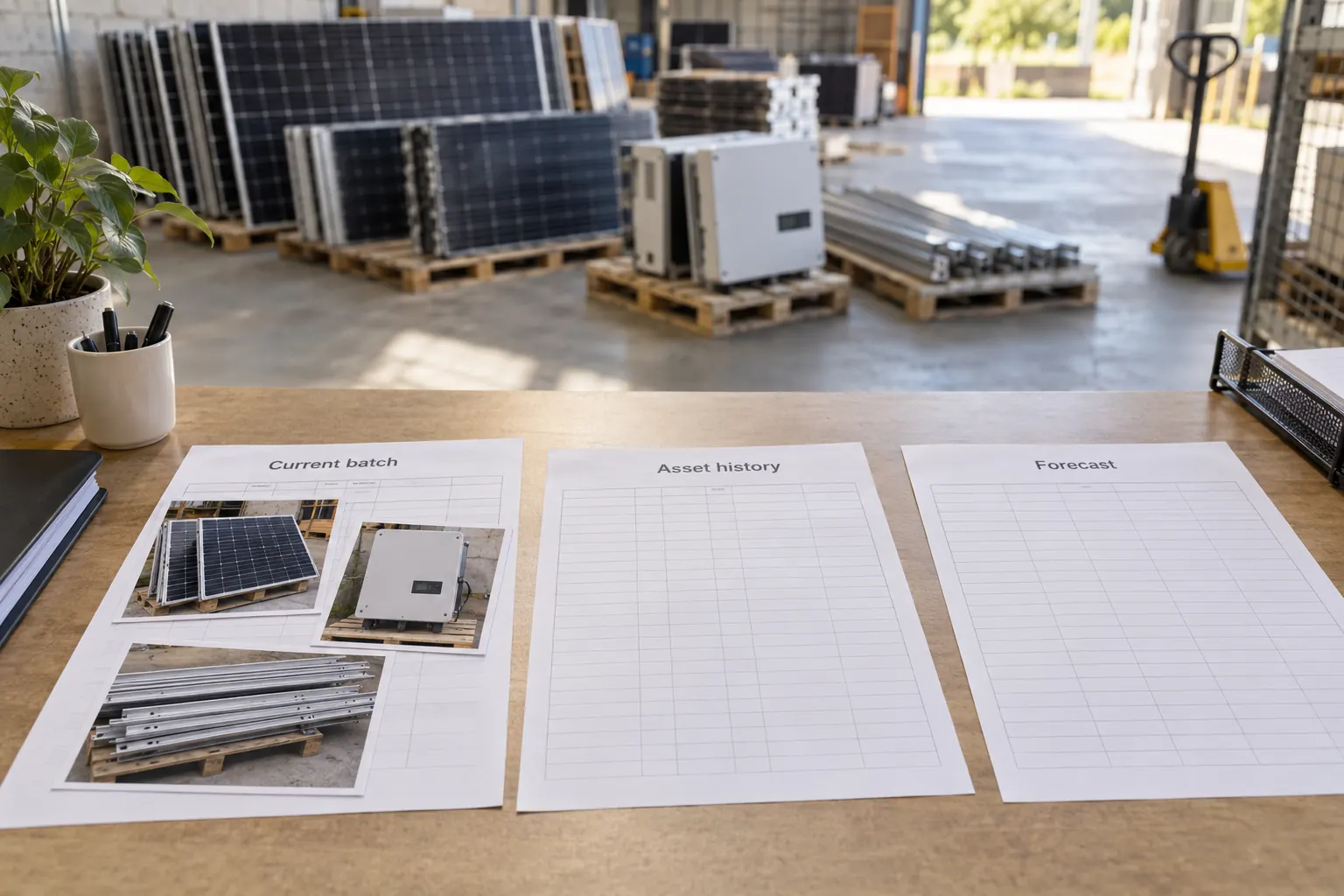
Give the record a batch reference, observation date, current point, postcode and correction contact. Existing removal or warehouse records can identify where a quantity came from, but their age and scope matter. ‘Reported by the current warehouse contact’ and ‘copied from the old asset register’ are different sources. If a row cannot be reconciled with the present point, retain the unresolved status rather than silently carrying a historical quantity into the ready batch. The warehouse batch-register guide supplies the broader ownership and change-control framework.
Compare a category ledger without manufacturing one combined total
The following is an illustrative administrative example, not a ReSova job, actual inventory or eligibility decision. Assume the responsible contact confirms the identified panel, inverter, rail and cable groups are already safely removed and present at ground-level point W-1. The last row has unconfirmed contents and is not a confirmed equipment quantity. Each observation keeps its own category, unit and uncertainty.
| Category | Current quantity and unit | Readiness and fact limit |
|---|---|---|
| Panels | 24 panels, current contact-confirmed count | At W-1 after qualified removal. Record visible-condition groups separately; count does not determine technical condition. |
| Inverters | 2 individual inverter units | At W-1 after qualified removal. Keep their own visible notes; no diagnosis or performance claim. |
| Racking / rails | 1 existing rail bundle; piece count unconfirmed | At W-1. Bundle count is not a measured rail quantity, loading solution or acceptance decision. |
| Cables | 2 existing coils; length and weight unconfirmed | At W-1. Do not substitute an assumed length or a combined panel-equivalent quantity. |
| Other / unresolved | 1 closed carton; contents and category unconfirmed | Disclose only known context. Do not count unidentified contents as confirmed ready equipment or assume inclusion. |
A useful summary repeats these distinct lines rather than adding them into a grand total. If the original project was described by a kW rating, that rating can remain background information. It cannot populate the current category rows. If an older asset list contains another inverter or more panels, the current contact must reconcile that difference before those items can be described as current. The system-size versus panel-count guide owns the broader capacity/count explanation; do not invent a conversion for this record.
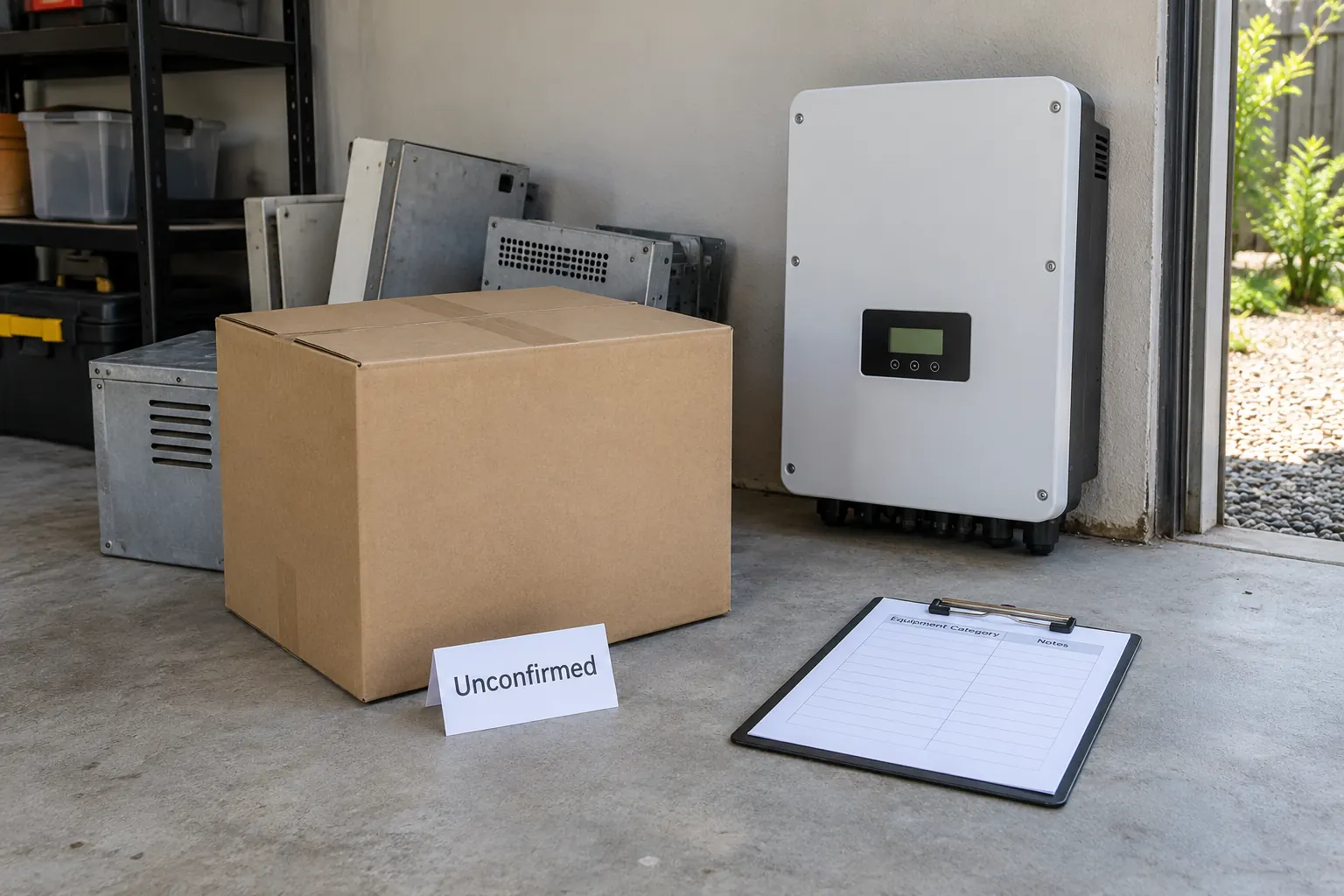
Unknown is useful information when it prevents a misleading assumption. A carton label or an obscured housing does not prove its contents, component category, removal status or suitability. Do not open, dismantle, test or create extra handling merely to complete this enquiry record. Batteries and unidentified items must not be assumed to sit within ReSova’s scope. Keep what is known as disclosed context and seek clarification from the responsible party; this guide does not classify material or provide specialist, electrical or legal advice.
Send the current category brief for tailored review
From mixed records to a factual review brief
- Name one present batch and pointIdentify the current ground-level location and contact for equipment already safely removed. Keep other sites and later stages separate.
- Retain each category and unitGive panels, inverters, rails/racking, cables and other disclosed equipment their own lines. Preserve unknown piece counts, lengths and weights.
- Check readiness row by rowSeparate confirmed current quantities from installed, connected, historical, forecast or unresolved material.
- Attach source and condition factsReference the current fact holder, record date, broad visible notes and available photographs without adding a technical assessment.
- Request review and update changed rowsUse Commercial Services for mixed-equipment scope and availability discussion. Replace the changed row and its source instead of treating a forecast as an amendment to a booking.
Send the current category lines, condition notes, postcode, ground-level handover point, known access facts and authorised correction contact through Commercial Services. A small panel count does not turn a mixed-equipment request into a standard panel-only estimate. The complete-system scope page explains category inclusion boundaries, and the condition-group guide helps keep visible observations precise. If a quantity or category changes, identify the updated line and retain the uncertainty that remains.
PV CYCLE International’s public form separates organisation/contact details from pickup-location and on-site-contact information. That is a useful comparison for keeping the location and contact beside, rather than merged with, an equipment record. It is not a ReSova form, Australian requirement or promise of collection. Australian Government consumer guidance directs removal and replacement to licensed electricians. ReSova’s assessment starts after qualified safe removal and ground-level availability, not with work on an installed system.
A complete category brief supports local Sydney or selected-NSW collection assessment only. ReSova does not provide electrical disconnection, removal, roof work, site-safety or traffic management, technical testing or legal advice. Listing a category does not promise acceptance, price, vehicle, route, timing, booking, recovery rate, reuse, recycling, processing or final destination. Online time selection remains paused. Use an enquiry, review and availability discussion rather than a direct booking request.
Sources and dates checked
- Australian Government — Replace and recycle your solar system, checked 12 October 2026: professional removal/replacement boundary only.
- U.S. DOE FEMP — Prepare for the end of a performance period, checked 12 October 2026: global comparator separating a PV array from balance-of-system categories. No decommissioning method, U.S. contract or rule is adopted.
- U.S. EPA — Solar panel recycling, checked 12 October 2026: global comparator distinguishing panels from related system components, not an Australian receiving option or acceptance promise.
- PV CYCLE International — Collection form, checked 12 October 2026: public organisation, pickup-location and on-site-contact fields only. Not a ReSova procedure, local eligibility rule or collection guarantee.
Key takeaways
- Category, quantity unit and current readiness are separate fields for every disclosed group.
- Do not add panels, inverter units, rail bundles and cable coils into one panel total.
- Keep historical assets, system ratings, forecasts and installed equipment outside confirmed current quantities.
- An unidentified item remains unresolved context, not a confirmed accepted category.
- Mixed equipment follows tailored enquiry and availability discussion, not a standard panel-only estimate or direct booking.
Frequently asked questions
Can inverters, rail bundles and cable coils be added to the panel count?
No. They are separate categories with different units. Keep panels as panels, inverters as individual units, and existing bundle or coil descriptions in their own rows without inventing piece counts, lengths or weights.
Does the old system size prove the equipment available now?
No. A system rating, historical asset list or project forecast is context only. A current record needs the actual categories and quantities already safely removed and available at the named ground-level point.
What should be recorded for an unidentified carton or component?
Describe only what is already known, such as one closed carton with unconfirmed contents. Keep identification, quantity and removal/readiness unknown where appropriate. Do not open, dismantle or test it for this administrative record, or assume that an unknown item or battery is included.
Does listing all component categories confirm one collection for the whole system?
No. It supports a tailored assessment only. ReSova must review the actual disclosed equipment, quantities, condition, location and access. No category, complete list or preferred timing confirms acceptance, price, vehicle, route, booking, recycling, reuse, processor or final destination.
Request a Mixed-Equipment Review
ReSova considers eligible, already removed equipment in Sydney and selected NSW areas after the ground-level handover and site access can be confirmed. It does not decide removal, technical condition or a final downstream outcome.