
Quick answer
An end-of-lease date is a prompt to coordinate the handover; it does not itself decide ownership, removal responsibility or collection readiness. The relevant property, lease and project parties should confirm their own responsibilities, permissions, dates and nominated contacts. Appropriately qualified people then manage electrical isolation and safe removal. Once the actual equipment is safely removed and ready at ground level, record its count, broad visible condition, other components, staging point and vehicle/loading access. ReSova can consider an eligible collection scope in Sydney and selected NSW areas; it does not provide lease, ownership, legal, electrical or removal advice.

Treat the lease exit and the collection handover as different workstreams
A commercial lease can end, be assigned, be renewed or involve a make-good programme, but this page does not interpret any of those arrangements. Victoria’s Solar for Business landlord and tenant guidance notes that a right to occupy may end before a system’s expected life. That is useful context for beginning a conversation early; it is not a rule for NSW, a conclusion about any contract or a collection instruction. Keep the property-side decisions with the relevant parties and keep the physical handover facts separate.
End-of-lease solar asset readiness matrix
| Question to confirm | Relevant party input | Information for collection scope | What ReSova does not decide or promise |
|---|---|---|---|
| Responsibility and permissions | The relevant landlord, tenant, asset, lease and project parties confirm their own obligations and site permissions. | Name a nominated site and day-of contact who can confirm access to the ready equipment. | Ownership, lease liability, make-good outcome, legal compliance or authority to remove equipment. |
| Safe removal | Appropriately qualified people and responsible project parties manage electrical isolation, removal and site controls. | Confirm that the eligible equipment has been safely removed and is ready at ground level. | Electrical advice, roof work, removal method, safety sign-off or technical condition. |
| Actual equipment | The site team reconciles panels and other components actually available after removal. | Actual count, broad visible condition and separately listed components. | A price, acceptance, reuse suitability, recovery rate or final downstream path from a forecast or lease date. |
| Staging and loading access | The property/site team agrees a protected ground-level location, route, gate controls and loading restrictions. | Staging point, vehicle/loading route, restrictions and nominated contact. | A particular vehicle, arrival time, loading capability or transport programme before scope confirmation. |
| Collection record | The site contact reconciles the handover information at collection where applicable. | The actual quantity and handover details recorded on a job docket. | A legal certificate, lease-compliance record, audit assurance, warranty proof or final-disposal certificate. |
Make the actual equipment and access visible before the lease handover date
The useful collection question is practical: what has been removed, where is it safely staged and how can the nominated contact release it? The DCCEEW National Solar Panel Recycling Pilot treats collection and transport as part of the broader end-of-life system. That national context does not create a local service entitlement or decide a project’s downstream result. It does support a simple discipline: do not use a lease date, roof estimate or assumed panel total as a substitute for the actual ground-level handover facts.
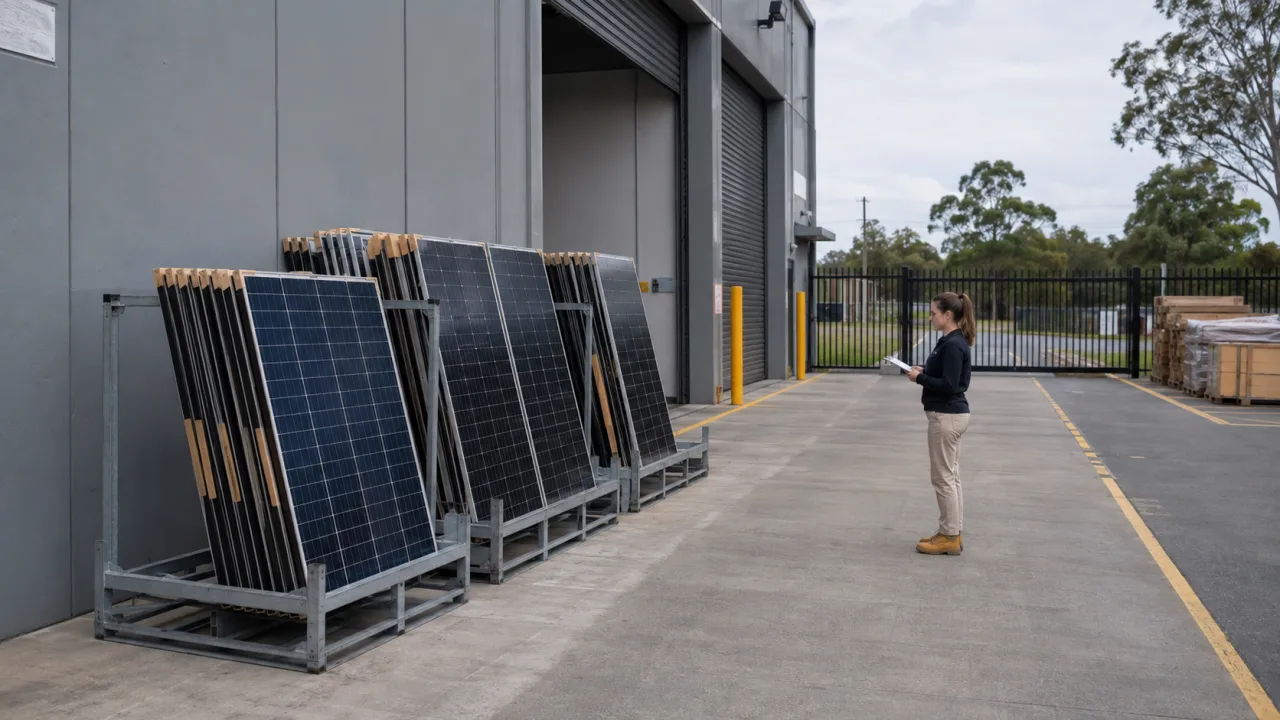
- Nominate the property or facilities contact who can answer site-access questions on the day.
- Confirm actual removed panel quantity, broad visible condition and any separately staged components.
- Keep the equipment at the agreed ground-level handover point and communicate gates, loading restrictions and route changes.
- Escalate 70+ panels, several contacts or batches, special equipment, restricted access or project-style work for a tailored scope.
A five-step end-of-lease collection handover flow
From property coordination to a ground-level equipment handover
- Keep responsibility decisions with the relevant partiesThe landlord, tenant, asset and project parties settle their own lease, permission, programme and make-good questions.
- Complete safe removalAppropriately qualified people manage isolation, removal and associated site safety before collection is considered.
- Reconcile the real equipmentList actual panel count, broad visible condition and other components available after removal.
- Set staging and accessAgree a protected ground-level handover point, nominated contact, gate arrangement and loading route.
- Confirm the collection scopeShare the ready equipment and access inputs; retain any job docket as a collection handover record only.
Use a tailored scope for complex commercial lease exits
An eligible standard 10–69-panel job may suit the collection estimator where the physical collection conditions fit. It does not settle a commercial lease-exit project. Use a tailored scope through Commercial Services for 70+ panels, restricted loading access, multiple contacts, several batches, special components or project-style work. A tailored scope is a clearer description of the ready handover; it is not a fixed price, collection-time, legal or downstream-outcome promise.

For Sydney and selected NSW commercial property teams
ReSova considers eligible, already removed equipment in Sydney and selected NSW areas once it is ready for a ground-level handover. Start with Commercial Services for a commercial enquiry, What We Collect for current equipment context and the commercial site handover guide for a different site-planning scenario. Keep lease documents, contractor records and property approvals with the appropriate responsible parties; a collection job docket is not a substitute for them.
Key takeaways
- A lease exit date does not itself decide ownership, legal responsibility, safe removal or collection readiness.
- Property and project parties manage lease, permission and programme questions; appropriately qualified people manage electrical isolation and safe removal.
- A collection scope needs actual removed equipment, broad visible condition, ground-level staging, access details and a nominated contact.
- A job docket records collection quantity and handover information only; it is not a lease-compliance, legal, audit, warranty or final-disposal document.
Frequently asked questions
Does an end-of-lease date decide who owns or must remove a solar system?
No. Ownership, lease obligations, permissions, make-good requirements and removal responsibility are matters for the relevant property, lease and project parties. This article does not provide legal or lease advice. A collection handover can only be considered once actual equipment has been safely removed and is ready at ground level.
Can ReSova remove solar equipment during a commercial lease exit?
No. Electrical isolation, roof work, safe removal and related site controls must be managed by appropriately qualified people and the responsible project parties. ReSova’s role begins only after eligible equipment is safely removed and available for a ground-level handover.
What should a commercial landlord prepare for a removed-panel collection enquiry?
Provide a nominated site contact, actual panel quantity, broad visible condition, separately listed components, ground-level staging location and vehicle/loading access details. These inputs help assess a collection scope; they do not establish lease responsibility, price, a collection time or a final downstream result.
Can the online estimate pathway cover every end-of-lease solar project?
An eligible standard 10–69-panel job may suit the online estimate pathway. A 70+ panel job, restricted property access, several contacts or batches, special components or project-style work needs a tailored scope. The online pathway is not a commercial lease-exit guarantee.
Does a job docket prove lease compliance or final disposal?
No. A job docket can record collection quantity and handover information for that job. It is not a lease-compliance document, legal certificate, audit assurance, warranty record or proof of a particular final downstream outcome.
Commercial Services
ReSova considers eligible, already removed equipment in Sydney and selected NSW areas after the ground-level handover and site access can be confirmed. It does not decide removal, technical condition or a final downstream outcome.