
Quick answer
Australia’s solar waste is climbing fast. Around 1.4 million modules were projected to reach end-of-life in 2025, and cumulative panel waste is estimated at roughly 685,000 tonnes by 2030 and about 1.16 million tonnes by 2035, with recoverable material value above A$1 billion. That scale is what’s driving new recycling capacity and a coming product-stewardship scheme.
The volumes
The near-term wave is already here: about 1.4 million modules were expected to retire in 2025, per PV Tech. Longer term, research from UNSW and the Australian Centre for Advanced Photovoltaics, cited by the Australian Energy Council, projects the totals below.
| By | Estimated volume | Note |
|---|---|---|
| 2025 | ~1.4 million modules (that year) | Near-term wave begins |
| 2030 | ~685,000 tonnes (cumulative) | Residential still dominant |
| 2035 | ~1.16 million tonnes (cumulative) | Utility-scale share rising |
The value
This is not just waste — it is material. Glass, aluminium, silicon, copper and silver in the retired fleet are estimated to be worth over A$1 billion in aggregate. That value is the core argument against landfill and the reason recyclers are investing in higher-recovery processes, covered in how solar panels are recycled.
The policy response
Australia is responding on several fronts: new recycling facilities (including in Sydney and the NSW Hunter Valley), a federal recycling pilot, and a national product-stewardship scheme being developed with NSW helping lead the work.
What it means now
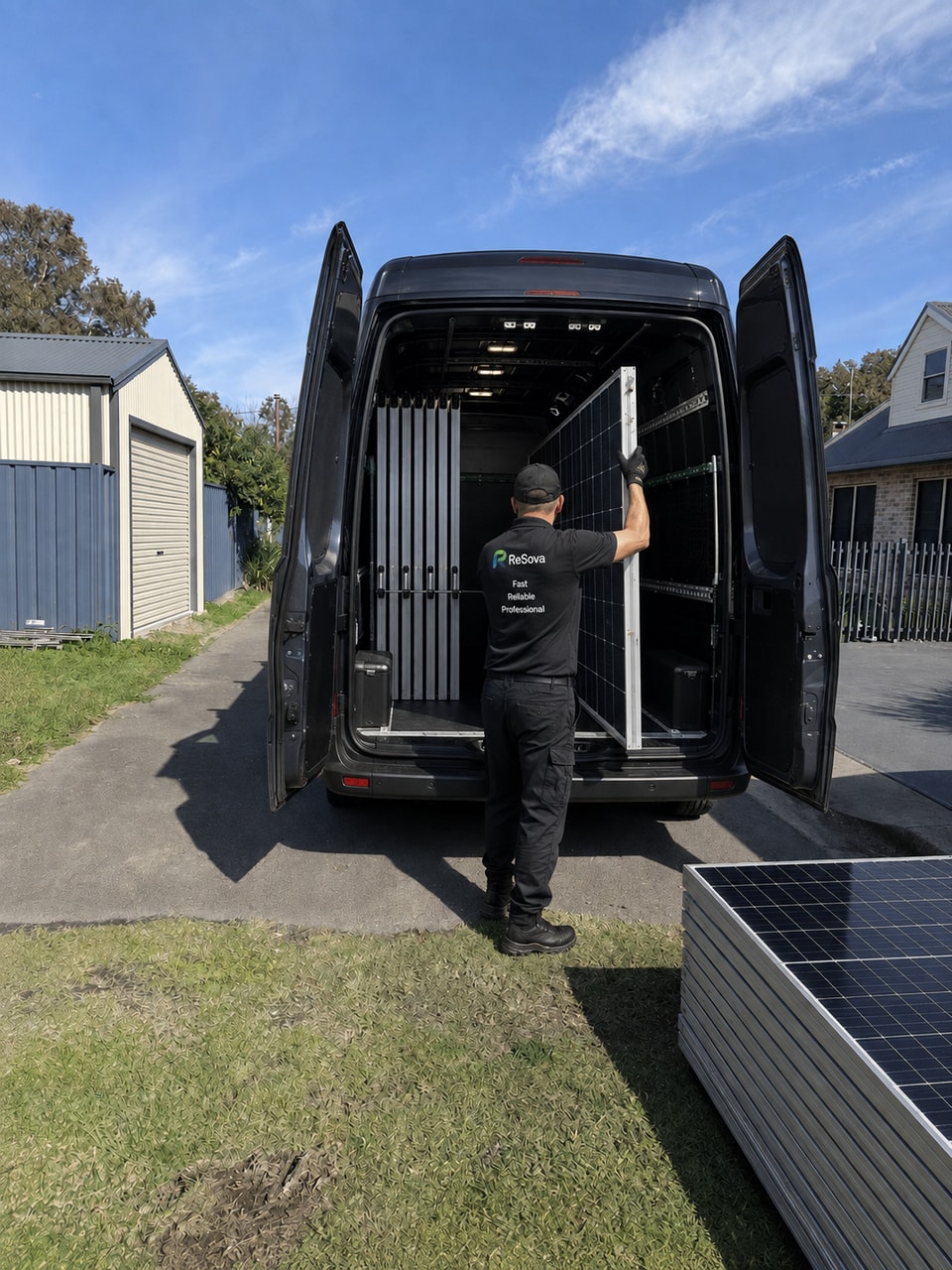
The infrastructure and policy are catching up, but collection remains a practical handover step after qualified people have safely removed the equipment. In Sydney, ReSova collects eligible ground-level equipment and documents the handover, then coordinates a suitable available downstream option without guaranteeing reuse, recycling or a destination. Get an indicative price with the estimator.
Key takeaways
- About 1.4 million PV modules were projected to reach end-of-life in Australia in 2025.
- Cumulative panel waste is estimated at roughly 685,000 tonnes by 2030 and ~1.16 million tonnes by 2035.
- Recoverable materials are valued at over A$1 billion — a strong reason not to landfill panels.
- New recycling facilities, a federal pilot and a coming stewardship scheme are the policy response.
- The practical gap today is collection: getting panels off site and to the right destination.
Frequently asked questions
How much solar panel waste will Australia have by 2035?
Research from UNSW and the Australian Centre for Advanced Photovoltaics, cited by the Australian Energy Council, estimates cumulative end-of-life solar waste at roughly 1.16 million tonnes by 2035, with about 685,000 tonnes by 2030.
Is solar panel waste valuable?
Yes — the recoverable materials (glass, aluminium, silicon, copper and silver) are estimated to be worth over A$1 billion in aggregate, which is a key reason panels shouldn't be landfilled.
What is being done about it?
New recycling facilities are opening (including in Sydney and the NSW Hunter Valley), a federal recycling pilot was funded in 2026, and a national product-stewardship scheme is being developed with NSW helping lead the work.
Get a collection estimate
ReSova considers eligible, already removed equipment in Sydney and selected NSW areas after the ground-level handover and site access can be confirmed. It does not decide removal, technical condition or a final downstream outcome.